


For centuries, man asked questions. He sat under a tree and thought, “Huh. Why is grass green?” or “How do trees know when to produce leaves?” and no one answered.
He might meet a friend at the tavern. They might speculate together. A diligent fellow might visit the library of a friend and seek some answers. He might go to a school or find a wise man in the village and ask him.
Physicist Richard Feynman explains that it is our nature to be inquisitive about the world around us. Our innate curiosity is the motor that drives us toward the truth:
“Curiosity demands that we ask questions, that we try to put things together . . .”
–Six Easy Pieces
The permafrost has begun to soften here in PA, and I took the students out to a grassy hill at W&J with an exercise for their curiosity: Sit, observe the physical world, and jot down 21 questions that come to mind.

Each of us came back inside with twenty-one new questions—and zero answers. It was an experience common to man. That is, common until recently.
These days, you have a question, you just ask Gemini. Question? Answer. Question? Answer. Question? Immediate answer. Every time.
At first blush, this instant accessibility feels like the dawn of some new enlightenment (it’s certainly being marketed to us that way!). But what exactly is it doing to our curiosity? Feeding it? Think about what happens when a question is allowed to marinade and linger. The longer it goes unanswered, doesn’t curiosity grow?
Like a vine, its tendrils wind through the chain link of our minds, invading our imagination with possibilities, probabilities, and more questions.
However, each time we turn to the phone or the nearest Amazon Echo, it’s like chopping that vine down to the root. Or, to borrow an example from school, it’s like doing your math homework with the answer key open right next to you. Nothing kills interest and curiosity faster than having all your questions answered immediately.
When my students and I returned from a “fruitless” hour of indulging our curiosity, we returned to the classroom with literal hundreds of unanswered questions. I asked them, “How much of the ‘knowledge out there’ has mankind actually discovered?” One speculated, “Maybe 2%.” Another, “20%.” I responded, “So let’s be generous and say less than half. And if we were to ask all of these questions of Gemini, how many would go unanswered? Zero.”
This is the second tragic result. When no question goes unanswered, we begin to believe that there is nothing left to be discovered. Ask? Answer. Ask? Answer. Ask? Answer. And before we know it, we begin to live as though man has found the end: No more knowledge out there! Nothing left to learn! We know everything.
We’ve successfully completed the project begun in Eden: we have become like God, knowing everything both good and evil.
Which, of course, is an absurd lie. An insatiable curiosity has been planted in the mind of man, and God has made a fruitful and multiplying world that unfolds new truth to satisfy every successive query. For those of us with a dulled appetite for the Good, the hunger might return if we relearn how to linger over unanswered questions.
An Appetite for Spring
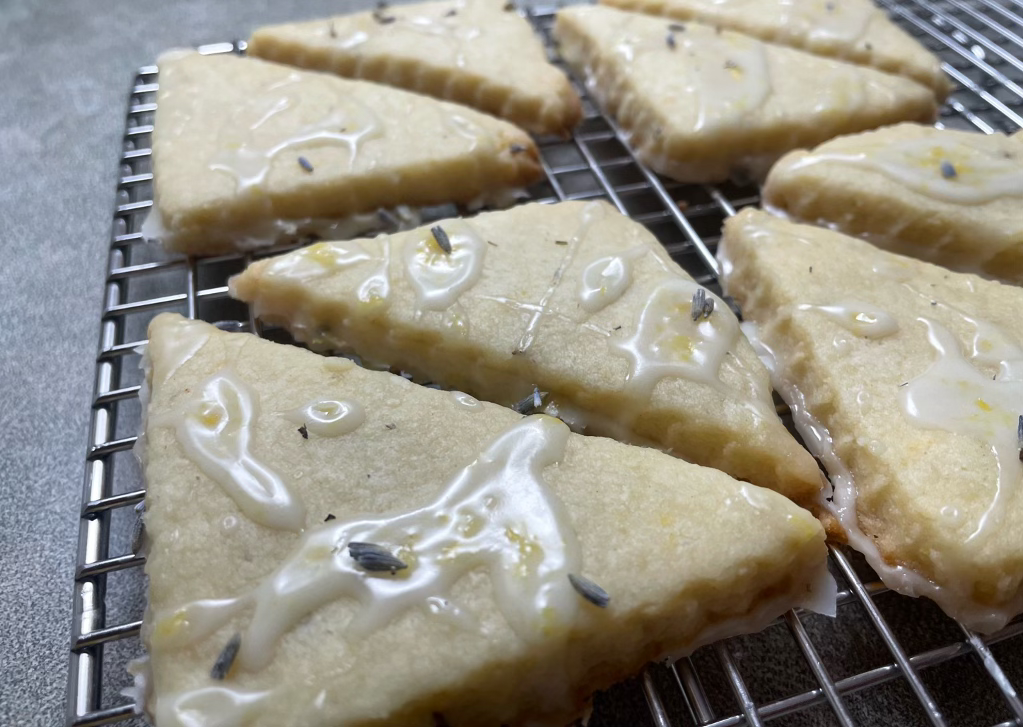
We are all hungry for warmer weather—here’s a great spring recipe!
I had been asked to cater a proper tea party—you know, the ones with the tiered scones and petit fours and cucumber sandwiches?—and the client specifically asked me to use this recipe from Three Olives Branch. I had to source dried lavender from the Fresh Market. I was skeptical. I shouldn’t have been. These pair the crowd-pleasing texture of shortbread with the familiar zip of lemon and the complex aroma of lavender. You will feel fancy without the fuss making these for your next tea time.
Ingredients
3 sticks soft butter
1 c powdered sugar
1 ¼ tsp salt
zest of 3 lemons
3 c flour
1 ½ tbsp lemon juice
1 ½ tsp dried lavender buds
Lemon glaze:
zest of one lemon
1 c powdered sugar
2 tbsp lemon juice
Preheat your oven to 325 degrees. Line a baking sheet with parchment paper.
In the bowl of a stand mixer fitted with a paddle attachment, beat the butter until smooth. Add the powdered sugar and stir on low until incorporated, then beat for a moment on high. Scrape down the sides of the bowl, then add the remaining ingredients. Stir on low until shortbread comes together as a uniform lump.
Dust the countertop with flour. Roll the dough out into a rectangle ½ inch thick. Using the wavy roller of your pastry cutter, cut the dough into a grid of 2 X 2-inch squares. Cut diagonally through the corners in one direction across the grid. This will create uniform triangles.
Transfer the triangles to your prepared pan and bake 25 to 30 minutes, just until the edges start to brown. Leave to cool on the baking sheet.
To make the lemon glaze, stir together ingredients in a small bowl. You may have to add extra lemon juice or water to thin it out. It should be runny enough to drizzle with a spoon. When the cookies are cooled, drizzle in spirals and random patterns across the pan of cookies. Sprinkle with a bit of dried lavender buds. The icing should harden in 10 minutes.
(makes around 3 dozen cookies)


