


I had to restrain myself this spring from peeking into our Art of Dance class too often. Last week, I heard clapping from the studio, and I was curious. Turns out the kids were enduring their final—a solo dance piece performed in front of their classmates.
I wanted to watch, reeeeeal bad. But it was a delicate situation—especially for the boys who were already self-conscious and trying to power through the embarrassment. The atmosphere was respectful, quiet, and filled with polite applause.
I had to tip-toe away. I knew the moment they felt my gaze, it would ruin the magic.
Simply by watching, I would change everything.
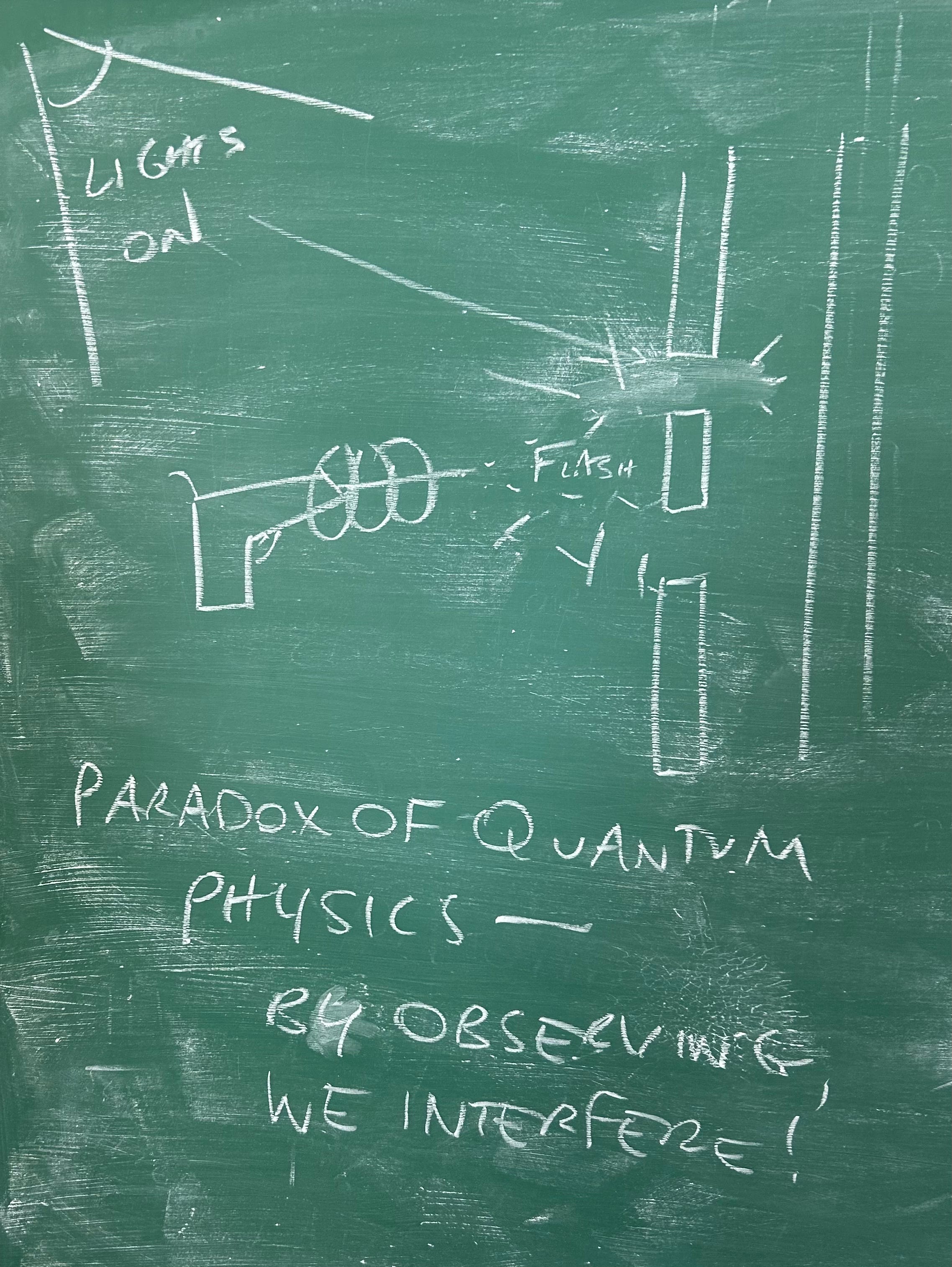
This is actually one of the fundamental paradoxes of quantum physics:
By observing, we interfere.
Physicist Richard Feynman illustrates this phenomenon using an electron gun experiment. If you don’t look, the electrons behaved like waves. But as soon as you turn the lights on and try to watch, the electrons behaved like particles. Strangely, the simple act of observation fundamentally changes the behavior.
The paradox of quantum physics is actually an illustration of God’s own nature: By observing, he interferes too.
In the creation account, we often emphasize that God is a speaking God—he creates by his word of power. But Genesis 1 has another point: Seven times we are told “God saw.”
God’s gaze never leaves a thing unchanged. By looking, he intervenes. In seeing, he acts. By observing, he interferes. Perhaps the most poignant instance comes in Exodus 2 where Moses writes,
“God saw the people of Israel—and God knew.” –Exodus 2:25
Moses isn’t speaking of a passive observer. Exodus 2 is the moment before God sends a savior. It is the catalyst for the plagues, the destruction of Pharaoh and his army, and the deliverance from the house of bondage. God saw the people of Israel is simply another way of saying God saved the people of Israel.
In seeing, he saves. Genesis 1 makes it clear that his gaze has touched the whole universe, including the quantum level: By observing, he interferes.
A Paradoxical Recipe
This scone recipe is somewhat of a paradox—so simple, yet so delicious. Cream Tea scones from King Arthur have only five ingredients and require almost no technique. But they taste smooth, delicate, and sophisticated. Serve them with you favorite jam!

Ingredients
360 g (3 c) flour
1 tbsp baking powder
1 tsp salt
65 g (1/3 c) sugar
1 teaspoon vanilla
340 g heavy cream
Preheat the oven to 425 degrees.
Add all the dry ingredients to a large mixing bowl. Measure cream and mix in vanilla. Add cream mixture to dry mixture. Use a rubber spatula to stir together. Stir from the outside of the bowl toward the center, pressing the mixture with the spatula to get it to adhere to itself.
Once all moistened, dump onto a flour-dusted counter. Flatten the dough and fold it over itself. Flatten again, this time into a circle 1-inch high. Use a bench scraper to cut down the middle of the circle. Cut across perpendicular to the first cut. You should have four perfect quarters. Cut each quarter into thirds, resulting in twelve wedges.
Use the bench scraper to scoop the scones onto a parchment-lined baking pan. Before putting them in the oven, use a pastry brush to add a bit of cream to the top of each scone. This will promote browning. Bake for 14 to 15 minutes or until just golden on top.
Leave to cool slightly, then slice in half and spread with your favorite jam!
(makes 12 scones)


